- May 8, 2015
Share
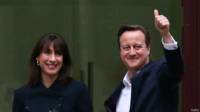
In the general election in Britain continues to count the votes. Published the results suggest that the Conservatives are the largest party in parliament and will be able to form a government.
According to forecasts Bi-bi-si, the Tories can get 329 seats – enough to form a one-party government.
After winning his precinct leader Tory David Cameron has promised to “unite the country” and said that its “goal is simple – to be the government for every citizen of the United Kingdom”.
Cameron also reiterated the Conservative election promise to hold a referendum on Britain’s membership in the European Union
The Labour Party, apparently, will receive a 233 House of Commons seats, the Liberal Democrats – only eight.
Labour leader Ed Miliband called the night of vote counting “a very difficult and sad night” for his party, and Liberal Democrat leader Nick Clegg described it as “brutal Night punishment “.
Everything points to the fact that the Liberal Democratic Party in the course of this election has suffered a heavy defeat, losing 47 seats in the Parliament.

The Scottish National Party (SNP) demonstrates a convincing victory over local Labour: apparently, she wins in 56 out of 59 districts in Scotland.
Total will elect 650 members of parliament. At the same time in 279 districts on the eve of elections to the local councils and elected mayors of several cities.
Across the UK on Thursday, there were about 50,000 polling stations. In London, the elections were carried out only to Parliament.

Some voters previously voted by mail. In the previous elections in 2010, postal voting was 15% of the total of 65% of voters.
For the first time in history it was possible register to vote by mail on the Internet.
The polling stations were equipped in schools, local cultural centers, religious buildings, pubs, laundries, mobile trailers, and even on school buses.
The elections were held 650 single-member constituencies by the majority system: in each district of the voters did not vote for the party and for a particular candidate – winning the one who attains a simple majority.
Analysis: Chris Mason, Bi-bi-si
After weeks of talks that the Conservatives and Labour are so aligned that the voting results can not be predicted, it turned out that the real situation is quite different.
Conservatives win very confident, and David Cameron for another term will remain prime minister.
It is not yet entirely clear whether the Tories gain enough votes to form a single-party government, but four results are clear:
- The Conservatives have made a much better result than many expected.
- Results Labour were far worse than they had hoped.
- worst fears were justified Liberal Democrats, although their leader Nick Clegg retained his seat
- The Scottish National Party (SNP) has achieved exceptional results, taking almost all the reserved seats in the Scottish Parliament.
What does this mean?
- A referendum on Britain’s membership in the EU will be held in the next two and a half years.
- The election of the new leader of the Labour Party.
- Election of the new leader of the Liberal Democratic Party.
- A noticeable growing influence of MPs from the Scottish National Party in the British Parliament.
The Scottish National Party has become the third largest in parliament a few months later after a referendum voted against the Scots that is the core of its policy – the independence of Scotland.
On Friday morning, we learned one more thing: as soon as the policy in the UK will not be boring.


No comments:
Post a Comment